
The Giant Manta Ray

I've always thought the ray species were beautiful. As a young teenager, I thought they were 'cool' when I saw the rays in SeaLife, and I would chuckle at how funny their mouths looked under their bodies. Of course, back then, I didn't know much about them. I thought their mouth, eyes and nose were all located on their underside and boy was I wrong.
Only recently did I learn about their correct anatomy, and I was (embarrassingly) shocked. The first ever ray I saw was the one I saw in SeaLife when I was younger, but there is a black diamond stingray at one of my favourite pet shops whose name is Pancake. The second I laid eyes on her, it was over - I was in love! In an alternate universe, she's mine.
After countless of times meeting Pancake, I knew that rays held a special place in my heart. They became my new obsession and they easily became high in my 'favourite animal list'. The manta ray was one of the first ocean creatures that I decided to study on and I want to share everything I've learnt with you about these angelic giants.
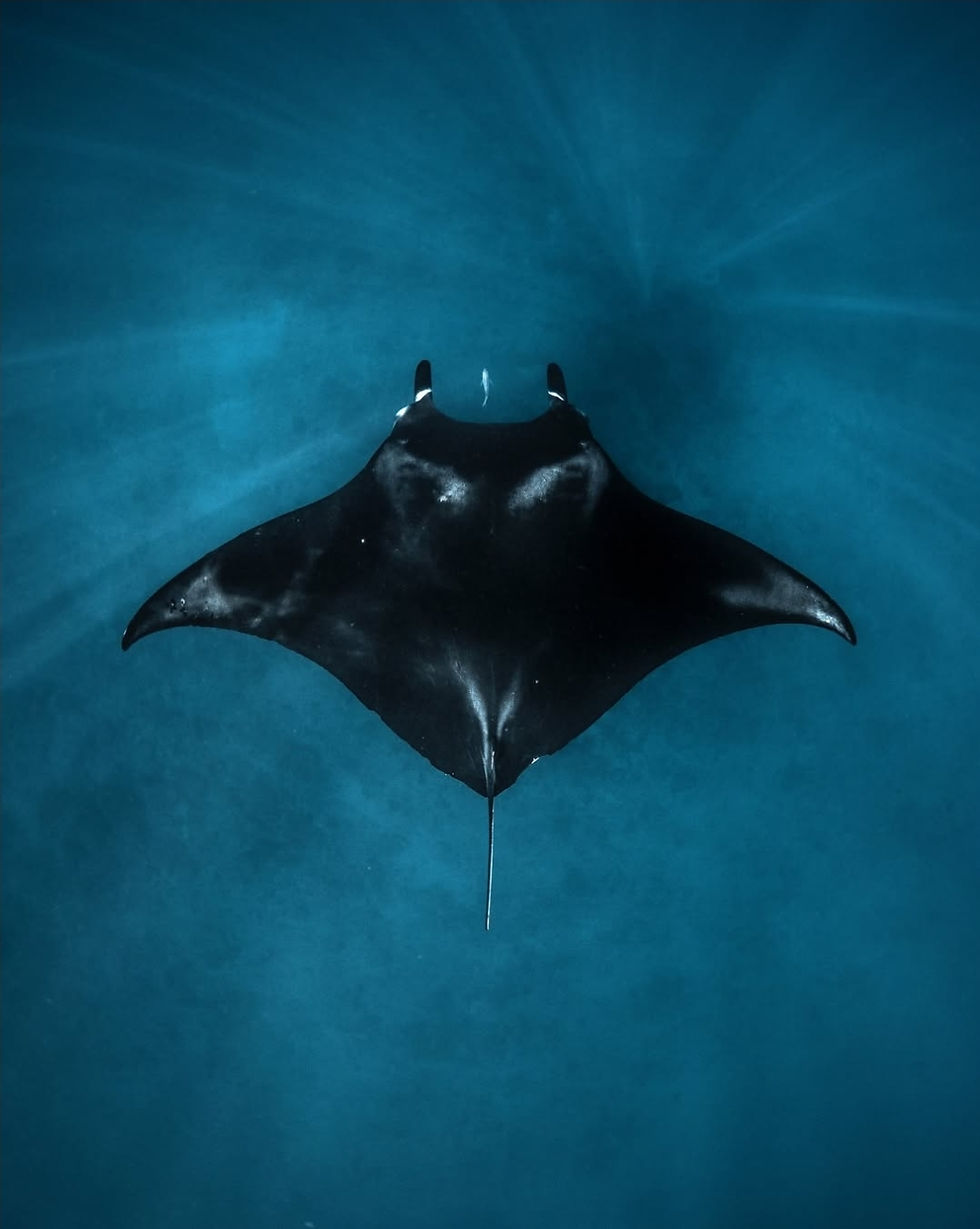
There is no better place to start than with their bodies. Manta rays are easily distinguishable from species of stingrays as their body shape is more diamond shaped or T-shaped, whereas stingrays are circular or a smoother diamond shape. On top of that, manta rays don't have a stinger at the base of their short tail, which means these creatures are harmless.
Moving up from the tail, the manta rays have two triangular shaped pectoral fins that flap slowly against the water, almost like mimicking a bird in flight. Their pectoral fins can span to lengths of 7 meters and they can weigh up to 3,000kgs! The pectoral fins have a huge role to play in the life of a manta ray. They move in a perpetual motion to keep having oxygenated water pass over their gills. If manta rays stop swimming, they may potentially suffocate and die, so you'll always see them on the move.
The head of the manta ray is interesting and I think is the best part of them. You'll notice two fins right in front of their head, which are called, cephalic lobes. Although you'll see the lobes just chilling about, they help the ray to filter in their food. Manta rays are filter feeders and rely on plankton to fill their bellies. Filter feeding is the process of gathering food and water but relying on gills to pass the water out of their mouths and keep the food in. They will open their mouth wide while swimming through a swam of plankton and the cephalic lobes help to scoop the yummy food in, then the gills will filter that water away and leave the plankton behind.

Spotted in Lady Elliot Island, its been noted that manta rays will come together and create a spiraling effect that catches the plankton in the middle, making it easier to gather food and eat together. Teamwork makes the dreamwork!

The eyes are placed on the side of their heads and they have been proven to have great eyesight with two blind spots being directly in front of them and directly behind them.

Fun fact:
Manta rays have no bones!
They are made out of cartilage which is what our nose and ears are made out of. This also means that rays are part of the shark family. The class containing both rays, skates and sharks is called: chondrichthyan. Rays also belong to a super order called: batodia/batomorphi.
Manta rays live worldwide, not ever settling on one particular spot. They can be spotted in tropical, subtropical, and temperate bodies of water and are usually found off shore.
Each manta ray is unique. They are all black with white undersides with black markings. These markings are as unique to them as finger prints are to humans. Australian biologist Dr. Kathy Townsend and her team at 'Project Manta' identify manta rays by taking photos of their underbellies, then copying those unique markings into a folder, which helps identify common individuals or if the team have spotted a new manta. This is done to help get an idea of the population, which I think is so amazing.
Documenting mantas like this can also help identify where they are travelling. The team will find one manta at North Stradbroke Island (located in Brisbane) and then find the same one north bound at Lady Elliot Island. It still blows me away typing this.

Bill Acker, a naturalist in a tiny island called Yap, has created a safe haven for possibly over 100 manta rays. Penalties of prison and fines apply if any harm is to come in the way of the manta rays he so carefully takes care of. Bill has been diving and assessing mantas for over 30 years and he actually has a old friend of his he can easily find - her name is Vallerina, named after his youngest daughter Valerie. Vallerina is approximated to be aged in her 40s which is proof that manta rays can live for a long, long time. Vallerina has a distinct 'V' shape on her underbelly, making it easy to find her.
Bill believes that manta rays are extremely intelligent. They have a large brain in proportion to their bodies and over the years of watching them, he believes that they look over us humans and can recongise us as well as we can recongise them. They are curious, friendly and gentle giants that deserve to be protected and cared for.

Fun fact:
Manta rays passed the mirror
self-recognition test, which means they
are proven to have self awareness.
Manta rays unfortunately have many threats to their lives. In the ocean, only really large sharks will attack them but its humans that pose the bigger threat. Fishing nets are a huge problem as manta rays are accidently caught or tangled in them, this also goes for fishing gear posing the same threat.
Overfishing is another immensely huge danger to them, as they are hunted for their gill plates which are in high demand for the Asian medicine market. Their gill plates can sell for $300 and although their meat isn't in high demand, it can be an easy replacement for shark fin soup.

Manta rays don't reproduce as fast as many other oceanic creatures (their sexual maturity develops at age 15 and they are pregnant for 12-13 months), meaning that when their population is decreasing, they are not able to keep up and have been considered a threatened species. At their sexual maturity, they are having one pup every two to five years. They are being killed at a faster rate then they can reproduce and its such a sad sight to see and read about.
Manta rays can also feed on the ocean floor, this poses a threat as they can be digesting micro plastics. They can also be struck and killed by passing boats while feeding on the floor or even while feeding/swimming normally in their habitat.
Pollution and climate change will forever be a threat to the manta ray and most, if not, all oceanic beings. Please be mindful when living your day to day life as even though you don't always see who lives in the ocean, they exist and need to be taken care of and protected so they can live the life they deserve. Even if you're unable to change your whole life, a little action goes a very long way.
Refer to my "Helping fight Climate Change" blog to see how you can help!
I just wanted to list some companies that you can discover that are helping donate money to help and protect Manta Rays.
World Treasure Designs has a range of beautifully designed jewelry that you can purchase. They are a member of the '1% for The Planet' network that help raise money to save oceans and environment. At least 1% of every purchase gets donated towards the cause.
Ocea Collective are another beautiful jewelry shop that are members of the 1% for The Planet network. They have donated over $13,500 to the conservation already!
Above and Below Gallery is run by Brooke Miles who photographs the ocean. Brooke sells prints of her work plus other amazing items! Above and Below Gallery are also members of the 1% for The Planet network, so they also donate 1% of their total revenue to the cause.
Project Manta is a research program based in Queensland. Dr Kathy Townsend and her team do an exceptional job with Manta Rays. You can follow along with Project Manta on Facebook and Instagram. They post updates and news on these creatures with gorgeous photos along with them.
Manta Trust is a UK based conservation using research, education and advice to help protect Manta Rays. You can also follow their socials on Instagram and Facebook and follow along in their journey. They also do accept donations through their website.
Marine Megafauna Foundation are a conservative program. They are globally recongised and non-profit. They help all ocean creatures, big and small. You can donate through their website or even adopt a manta!
Thank you all for joining me on my educational journey with Manta Rays, whom now have a special place in my heart. I hope you've learnt something new in my blog and in my many more blogs to come!


This was fantastic reading. So educational and informative. Thanks for your blog annelise Dominello.
Wow, these majestic creatures are incredible! I’ve learnt so much from your blog, I had no idea how amazing they were 😍
I learnt so much more than I ever thought I’d know about manta rays! Thank you so much for showing us an extension of your passion towards animals of all kinds, beautifully written and beautiful site you’ve constructed friend.